
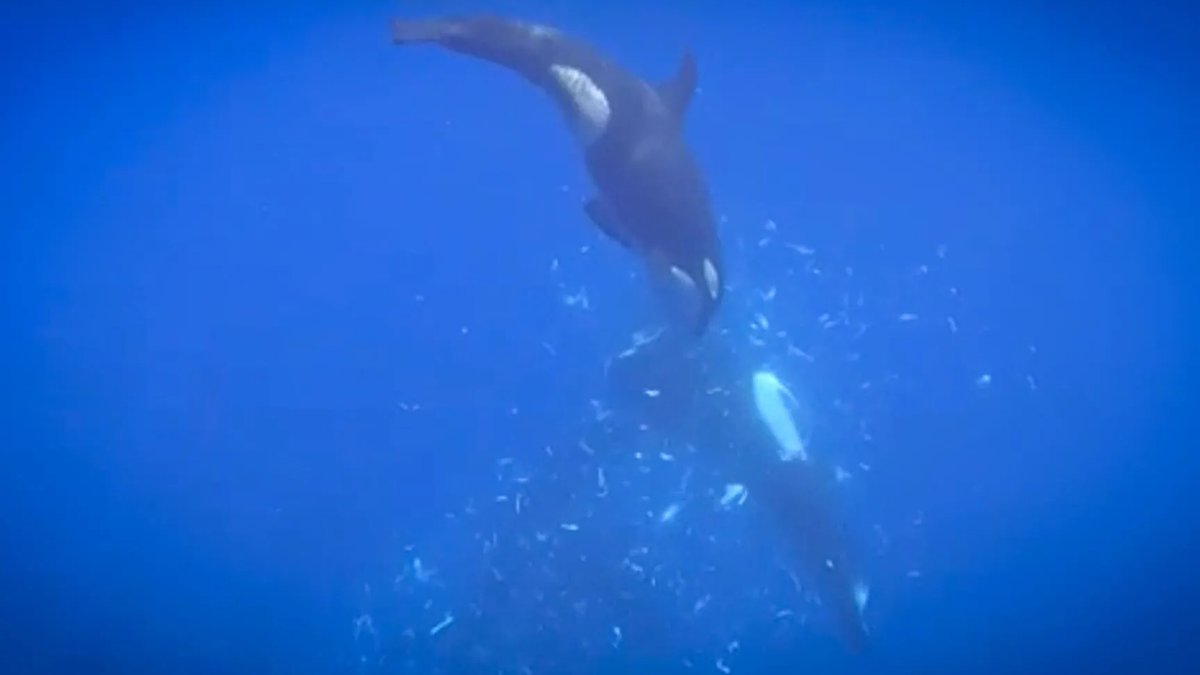
Orcas have been filmed smashing giant sunfish into thousands of pieces, revealing a new predation strategy in the Gulf of California. Researchers observed a coordinated hunt where one orca holds the prey while another strikes it at high speed, disintegrating the animal’s body.
Dr. Kathryn Ayres, the first author of the Frontiers in Ethology article, noted that the team documented how one orca holds the sunfish and releases it just before another hits it. “We think this may help younger orcas feed more easily or it could also just be for fun,” Ayres said. “Orcas are known for playing with their food.”
Sunfish can exceed three meters in length and weigh as much as 2,000 kg. They often rise to the surface to rest, regulate their body temperature, or have parasites removed. This behavior leaves them exposed to predators in the Gulf of California, where they are frequently hunted.
Related: Depression symptoms often go beyond sad feelings
The newly reported behavior was recorded during two separate events that took place slightly more than a year apart. In July 2024, Ayres watched a group of orcas, including a juvenile, handle a dead sharp-tail sunfish. A female gripped the fish by its large tail fin, providing a secure hold while a male gained speed and charged. The female released the sunfish just before the male struck it. The force of the collision broke the fish’s tissue into fragments that drifted through the water. The juvenile then ate the smaller pieces, while the adults consumed the remaining carcass but left the scattered fragments behind.
A second incident was filmed by Héctor Franz in September 2025. It followed the same sequence of holding, releasing, ramming, and feeding.
The forceful collisions caused much of the prey’s tissue to disintegrate. Ramming has not previously been documented as an orca predation strategy. In both cases, the animals appeared to work together. One orca held the carcass steady, allowing the other to strike it with greater precision.
Because the sunfish were already dead, the researchers believe the impacts were used to process the prey rather than kill it. Sunfish have a gelatinous outer layer known as capsule, and both this layer and the skin contain a distinct microbiome. When the tissue breaks apart, the microbial taxa living within it spread into the surrounding water and change its nutrient composition.
Related: Top 6 email marketing tips for small businesses
This fragmentation may increase contact between sunfish and orca microbiomes. Researchers suggest that such exposure could offer nutritional advantages or other benefits, including possible immune regulation. The behavior may also represent parental investment, as breaking the carcass into smaller portions would make it easier for a calf or juvenile to feed.
Despite these theories, the interactions could have had a social function, or the orcas may simply have been playing. The observations may also reveal something unusual about sharp-tail sunfish. So far, this type of tissue fragmentation has only been recorded in that species. The researchers suggest that sharp-tail sunfish tissue may respond to powerful impacts in a distinctive way, whereas other, larger sunfish species may not break apart as easily under similar conditions.
Scientists do not know whether the same orcas participated in both events. More high-quality footage is needed, particularly clear views of dorsal fins and eye patches, which can be used to identify individual animals.


Leave a Reply